Midsummer
contributed by Sarah Emily Duff

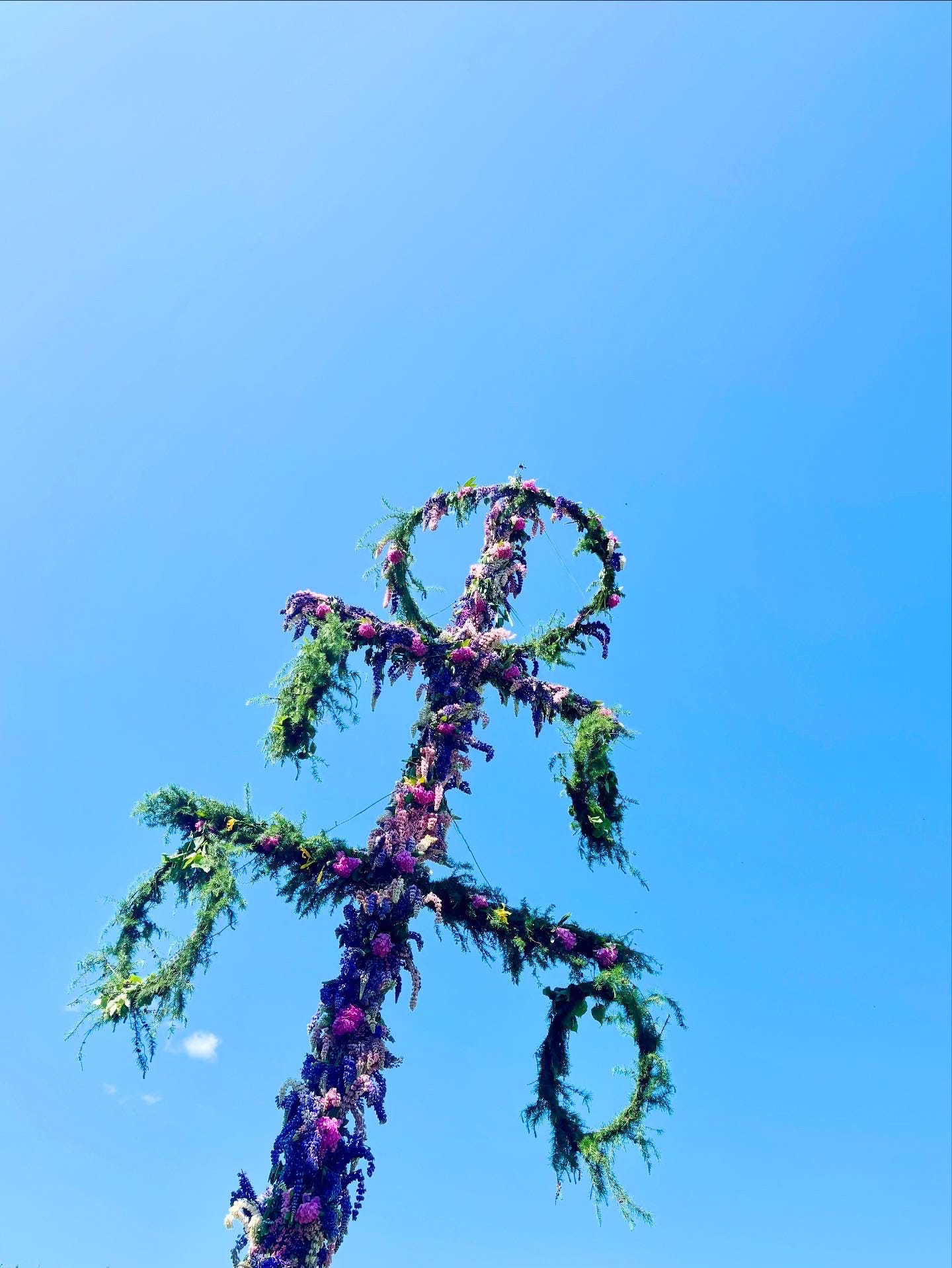
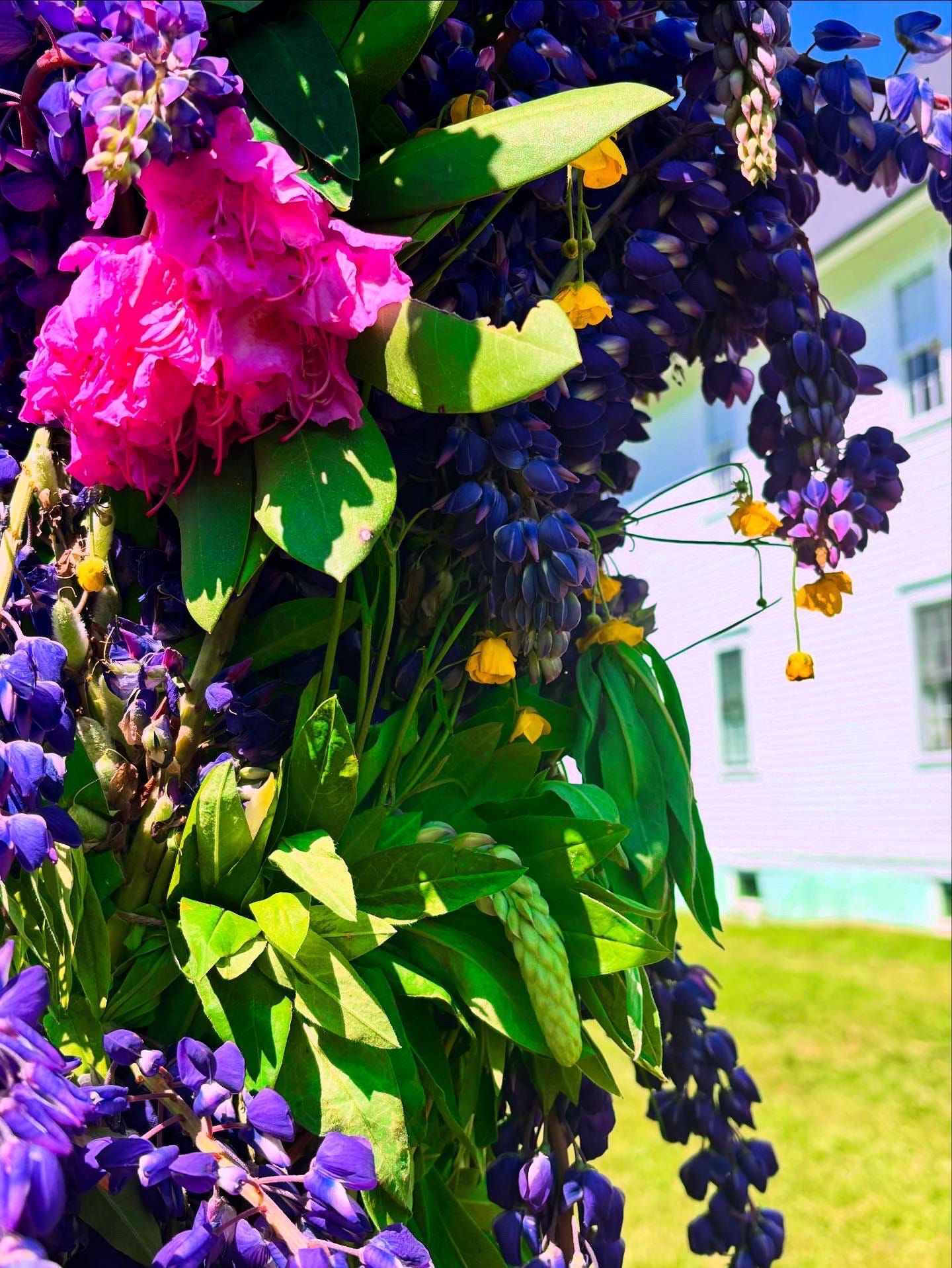
Over the weekend I drove four hours north to Swedish Colony, a pocket of land in the uppermost reach of Aroostook County. In 1870, the state of Maine sponsored a group of about fifty settlers from rural Sweden to establish farms in what remains a relatively remote area of the state. Every year the town of New Sweden (pop. 577) holds a midsommar festival. On the day before, flowers are gathered; the maypole is decorated on midsummer itself; and there is dancing and other festivities at a nearby park the day after. This year, the weather was gloriously hot and bright on the 21 st , with the maypole—in a design typical of Jämtland, the region from which most of the settlers originated—adorned with the lupines that grow abundantly at this time of year. It poured with rain on Sunday, but neither that nor the ferociously hungry mosquitoes put a stop to the folk dancing and folk music.
I lugged Clarissa with me on my midsummer expedition, and was struck as I read by both the mosquitos, as well as by the fact that reading the novel in real time has drawn my attention to the continuities between my own circumstances and those of the characters of the novel. I experienced spring with Clarissa and her chickens, and now we have all entered summer. And I think it is an interesting coincidence that the ‘heat’ of the novel—its most violent episode so far—occurs as we near midsummer. And on midsummer eve—on 20 June—Lovelace describes in letter 271 a ‘a profound reverie; which brought on sleep; and that produced a dream; a fortunate dream’ which, he hopes, ‘will afford [his] working mind the means to effect the obliging double purpose [his] heart is now once more set upon’. The dream is wish fulfilment and also Lovelace’s attempt to assuage his conscience. He dreams that his assault of Clarissa results in reconciliation and then ‘as quick as thought … ensued recoveries, lyings-in, christenings, the smiling boy amply, even in her own opinion, rewarding the suffering mother.’ They live on her ‘grandfather’s estate’ and their son when grown up marries the ‘charming’ daughter of Miss Howe, also fathered by Lovelace, ‘in order to consolidate their mammas’ friendships (for neither have dreams regard to consanguinity).’ The ensuing letters’ preoccupation with Lovelace and Clarissa marrying by 29 June stems from the dream reminding him that that date is her uncle’s ‘anniversary birthday’ meaning that their ‘nuptials should be then privately solemnized in his presence.’
Of course, this is not the first dream in a novel which is interested in dreams, sleeping, sleeplessness, and wakefulness. The excellent Terry Castle (could I recommend her essay about Susan Sontag for the London Review of Books if you ever need a little pick me up?) wrote ‘Lovelace’s Dream’, for a 1984 edition of Studies in Eighteenth-Century Culture. She argues that the dream is the fulcrum on which the novel turns: it is both a prediction for what happens next (and Lovelace is pleased about what he considers to be the predictive quality of his dream in letter 272), and an interpretation of the plot (Castle is also interested in plots and plotting). I think that this quote doesn’t provide too many spoilers:
Lovelace’s dream addresses us, then, with two mouths: it both lies and speaks the truth about the future of that narrative in which it is embedded. It admits of two contradictory propositions simultaneously: that it is both ironic and non-ironic, that it fails to predict the outcome of plot in Clarissa, and at the same time, predicts it. It is both joke and allegory. This indeterminacy, what one might call the multivalent affect of the dream, is in accord of course with its own contradictory ‘plot’ and the story it tells—of perverse exchanges, metamorphoses, and endless transformations of things into their opposites. Like all dreams, Lovelace’s vision has to do most profoundly, not with the either/or, but with the both/and. On every level it subverts the notion of mutually exclusive possibilities and instead … merges contraries, fuses opposites.
I like Castle’s interpretation, but I would prod her to think a little more about the date of the dream’s occurrence. It happens not only halfway through the novel, but also at midsummer. It is a midsummer night’s dream.
Pre-Freudian Lovelace thinks of his dream as evidence of other-worldly forces working in his favour: he has ‘fine helps from some body, some spirit’ as even ‘a Beelzebub has his devilkins to attend his call.’ Midsummer, as Shakespeare fans will know, is a time of celebrating the return of the sun, brightness, and warmth, and a few days when the usual rules governing social behaviour are lifted: women pursue men, aristocrats mingle with peasants, fairies intervene in the lives of humans. There is, though, potential darkness in all this light. In 2023, I saw a production of A Midsummer Night’s Dream directed by Elle While at the Globe in London, which, in emphasising the fact that a kidnapping is at the heart of the play, pointed out that fairyfolk were seen in the early modern and medieval world as amoral, at best, and extremely dangerous at worst. The revelry and disorder of midsummer could also be threatening and violent.

I think that something similar is at work in Clarissa. At midsummer, Lovelace violates Clarissa. And yet shortly after, he begins to convince himself that she will marry him—something of a shift for someone hitherto ambivalent about marriage (he resolves to marry her ‘in defiance of all [his] antipathies to the married state’). At this moment, Clarissa’s refusal becomes especially remarkable: she has been raped, imprisoned, and deceived, and yet she will not give in. Absolutely, she will not. It is striking to me that we do not hear from Clarissa at all this week: she will not write to Lovelace, she will not answer him. But her silence here is not silencing, it is defiance. I would suggest that these acts are not indicative of transformation—they are, rather, revelations of that which has been hitherto unclear: Lovelace is no complex anti-hero, but, rather, a self-obsessed, brutal, and brutish cad; Clarissa is the brave and moral and ethical heart of the novel. In Clarissa, where it is not always clear who or what is good in the first half of the novel, midsummer in its capacity to turn things upside down, serves as a moment of profound clarification. In the bright sun, we can see.
Sarah Emily Duff is Associate Professor of African and World History at Colby College in Maine. She is an historian of age, gender, and reproduction, and has written books about childhood and youth. She’s currently interested in histories of sex education and menopause. And heliacal rituals.
What a gorgeous, haunting, spot-on commentary! You know, when I read the description of the 'dream' I assumed it was Lovelace being arch about his plans, pretending he'd spontaneously just dreamed them. It hadn't occurred to me that maybe he HAD actually dreamed them. But the conflicted nature of the dream you describe so well here really does characterize post-rape Lovelace perfectly: he wants all sorts of mutually incompatible things, he's falling apart, like a top spinning out of control, incoherently emitting random plots and hopes and tears and vows and threats and regrets as he staggers around. You've made me think that his psychological disintegration is a dream logic - he is, as they say, living the dream - but not in a good way.
I must confess that when I saw the title I thought this was going to be about Ari Aster's movie Midsommar and I was very confused about how that could connect to Clarissa 😂
This is so beautiful! I really like how you describe the ability of dreams and midsummer to capture the hallucinogenic-like qualities of this stage of the novel. The drugging, Clarissa's addled state in the days following the assault, and Paper X with all of its sideways phrases feel like a trip. Writing, and by extension her mind, was Clarissa's single safe retreat, and now even that has been taken from her.
I really appreciate the characterization of her silence as defiance, though... and even when she speaks, it's to say "no, I will not marry you." It's brutal and achingly beautiful, something like Cordelia's response of "Nothing" to King Lear (to continue the Shakespeare theme). Maybe I'm romanticizing (or perhaps projecting?) but I think there is so much power in hearing a woman say NO. I'm relishing how baffled Lovelace is by Clarissa's defiance of his "once subdued, always subdued" saying.