Plotting
contributed by Sarah Emily Duff

As I’ve read Clarissa I’ve thought most frequently about two book reviews, one of which, alas, seems to have been swallowed by the internet. That one must have been published at least fifteen years ago because it’s a review of Roberto Bolaño’s monstrous—in length and, to some degree, in content—2666, which I read in a kind of feverish obsession in the months after finishing my PhD. (I also made my way through War and Peaceat about the same time, suggesting that my first response to acute stress and uncertainty is to seek out novels that are so long that I risk suffocation if reading them propped up in bed.) This particular review—and, readers, I have tried so hard to find it—describes the physical experience of reading 2666 in hardback, uncomfortably unwieldly to read and increasingly battered as the reviewer lugs it with him on trains and in taxis. My copy of Clarissa is beginning to look similarly well used.
And I’ve been thinking of Martin Amis’s brilliant review of Don Quixote, first published in the Atlantic in 1986, and then anthologised in The War Against Cliché. It captures exactly why Don Quixote is essential, why it’s so influential, and why it’s important to read while acknowledging at the same time that it’s an absolute slog to get through:
While clearly in impregnable masterpiece, Don Quixote suffers from one fairly serious flaw—that of outright unreadability. This reviewer should know, because he has just read it. The book bristles with beauties, charm, sublime comedy; it is also, for long stretches (approaching about 75 per cent of the whole), inhumanly dull. … Reading Don Quixote can be compared to an indefinite visit from your most impossible senior relative, with all his pranks, dirty habits, unstoppable reminiscences, and terrible cronies. When the experience is over, and the old boy checks out at last (on page 846—the prose wedged tight, with no breaks for dialogue), you will shed tears all right: not tears of relief or regret but tears of pride. You made it, despite all that Don Quixote could do.
I don’t think that I could apply this assessment fairly to Clarissa, even if I flagged somewhat during March’s correspondence. What Amis conveys, though, is what it’s like to read a book which is a novel-in-the-making. There is one observation which does feel apposite, even if only for some sections of the novel:
His epic is epic in length only; it has no pace, no drive. An anthology, an agglomeration, it simply accrues. The question ‘What happens next?’ has no meaning, because there is no next in Don Quixote’s world: there is only more.
This description of the lack of pacing—of more and not next—feels right for a novel in which we can feel the author sweating to manoeuvre his characters into the right places at the right time—and in the right letters—for the next event to be able to occur. Others have described the action of this novel as propulsive, as hurtling, and I think that’s really spot-on: we lurch forward, halt suddenly, wallow, and the move swiftly along again.

For this week’s reading, I was struck especially by letter 182, from Clarissa’s mother to Mrs. Norton, Clarissa’s nurse. In this anguished maternal condemnation of Clarissa, one particular accusation stood out: “Her fault was a fault of premeditation, of cunning, of contrivance. … Oh this naughty, naughty child who knewso well what she did…” According to her mother, Clarissa has not only been untruthful, but she has also been manipulative. She has been furtive and conniving—we know that the has been planning to run away with Lovelace, and her mother casts this as a profoundly dishonest and devious scheme. Clarissa has, in other words, been plotting. Here, we might think of ‘plotting’ in its political sense: of conspiracies, palace intrigue, and of nefarious and underhand deals. But of course we know that to think of Clarissa behaving in these terms is completely ludicrous. She is an absolutely hopeless plotter: she constructs plans which fall apart, and she makes decisions—one especially—which land her in even worse conditions than those from which she fled. And that bad plotting is evidence of Clarissa’s virtue. Her artlessness, willingness to trust her friends, and her desperate efforts always to choose the more moral path mean that her capacity to plot is rather undermined. This is all contrast to Lovelace, an inveterate and usually quite inventive plotter.
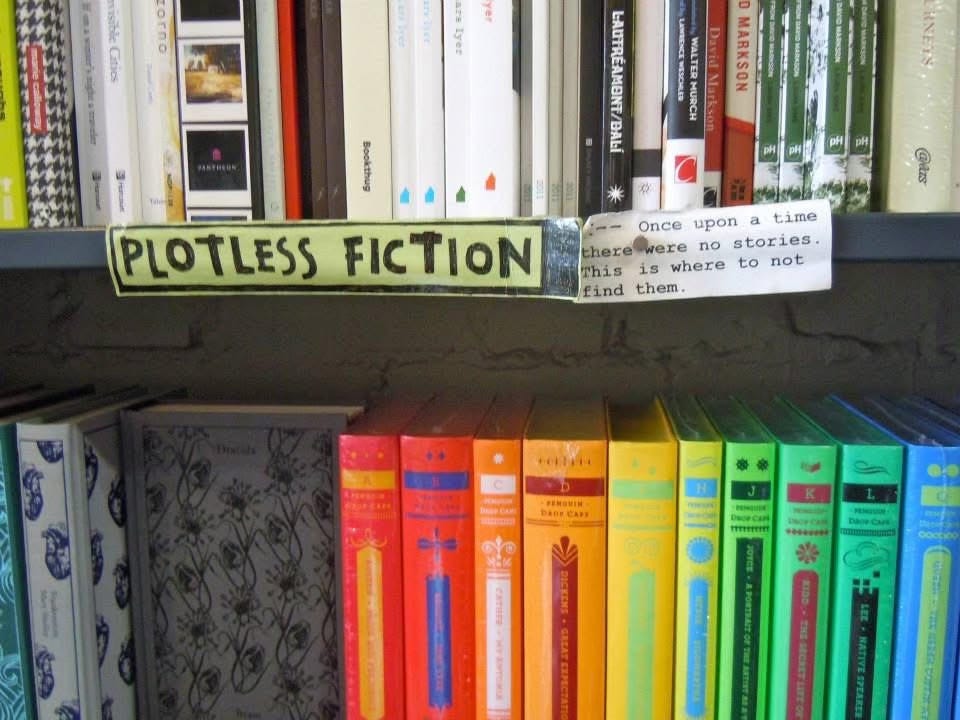
So if we understand that plotting is linked to deception, then how does the genre of the novel—accused of undermining the morals of its readers—relate itself to plot? I would suggest that the role of the plot in Clarissa is a moral one: quite simply, it shows us how actions have consequences. We read the reasoning that characters provide for their decisions (and we judge them for their excuses or arguments), we learn about what they do, and we watch as the consequences unravel. This is a moral education. But the plot proceeds less as a well-structured series of events (the ‘pace and drive’ to which Amis refers) and more as ‘more’ because it is fairly close to how real life unspools. We create plots for our own lives usually only in retrospect—making order out of the chaos of ordinary life through narrative. In fact, Clarissa points to this in an interesting comment appended to letter 182: it was “not communicated until the history came to be compiled.” Richardson reminds us here that we are reading a kind of case study which attempts to provide us with as much useful information as possible—hence the inclusion of letters which might not have been sent or read—but which is also, at the same time, a correspondence proceeding in real time. This is a recreation of real, plotless life while at the same time an attempt at forming this plotlessness into a coherent and moral whole.
Sarah Emily Duff is Associate Professor of African and World History at Colby College in Maine. She is an historian of age, gender, and reproduction, and has written books about childhood and youth. She’s currently interested in histories of sex education and menopause. And plots.
I love this post too, and among other things I find it a wonderful companion piece to Stephanie's reflections on going steady with Clarissa. Both posts think about the literary and affective implications of being immersed in such a long-term, mundane, slow-moving, narrowly focused world, in which after a certain point we're reading less for plot (though plot is hardly irrelevant, and sneaks up on us at moments throughout!) than for feeling and domestic absorption. I'm reminded too of my earlier reflections on the echoes of epic - there's something of that duration and scale here, and both the Iliad and the Odyssey similarly have plenty of stints that one could sit out without missing much in the way of actual plot development. But the emphasis on domesticity and interiority here feels very different, not only from epic and Cervantes (which one could describe as mock-epic) but even from Tolstoy. As Stephanie points out, the status of Anna Karenina complicates identifying Clarissa's lower visibility simply with its focus on women's lives, but its insistently small focus (despite its equally insistently large heft) diverges from these more touted epic-invoking novels in ways that go beyond protagonists' gender. It's really illuminating to be reminded, while living breathlessly inside individual episodes, to step back and see the forest as well as the trees. It's also a reminder that by now we have covered some serious ground!, page-wise as well as plot-wise. Very satisfying to reflect on how this world has become an ongoing part of my life's rhythms and routines - and among other things a happy reminder that, as bad as the world around us is currently looking, it could be worse, I could be locked in a closet entirely in the power of a cohabitating, darkly plotting predator, excommunicated by nearly all, with only one friend for solace!
Oh, how I loved this post! I’ve been thinking a bit lately about why Richardson doesn’t typically get classed with Tolstoy and Cervantes (and Bolaño), at least in the popular imagination. There’s so much that’s consonant in these big ambitious books. The status of Anna Karenina suggests that it’s not just bias against the representation of women’s lives. So what is it about this one? Maybe I’m just feeling defensive. Because for me it’s every bit as big of a book. Anyway, I really appreciated this attention to the meanings of plot and the kinds of pace that result from Richardson’s uses of plot. At times we get something like suspense but it’s just as often thwarted. The novel isn’t as digressive or episodic as Don Quixote. It’s a different problem of attention. Instead of wandering attention, we get all-too-focused attention, a hyper-focus we keep wanting to look away from. No spoilers, but I think that might even compound in the next few weeks. We’re dared not to look away.